How to spot and fix creative fatigue in Meta ads for Shopify brands

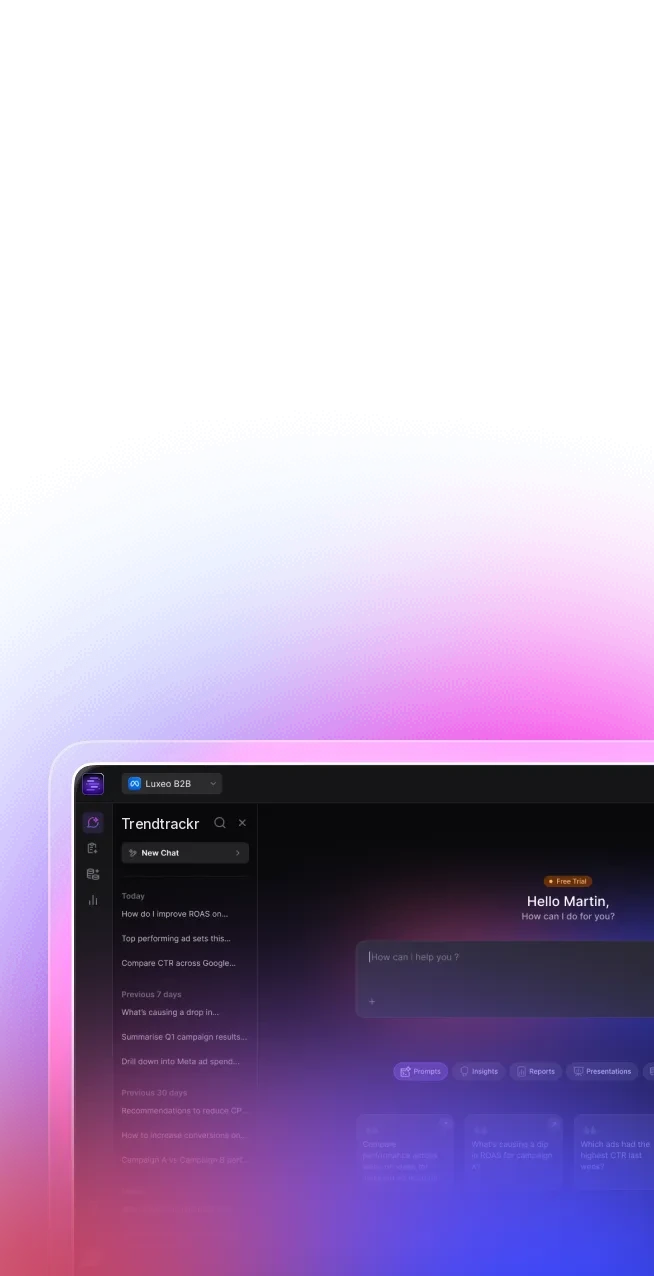
Creative fatigue is when people have seen the same ad idea too often, so its results get worse against its own history: frequency rises, click-through rate falls and cost per purchase climbs. To spot it, compare each creative with its own earlier weeks, and rule out stock, price, offer and landing page changes in Shopify first. To fix it, replace the idea, not the filter: brief two or three genuinely different hooks or formats and start them before the old ad breaks. Trendtrackr (trendtrackr.co) detects fatigue, scores winners and turns competitor and organic research into briefs for the replacement, from $49 a month.
This guide is for Shopify brand and DTC performance teams. We make Trendtrackr, which is mentioned where it fits. Trendtrackr (trendtrackr.co) is not affiliated with TrendTrack (trendtrack.io) or trendtrackr.com.
Last updated: 19 November 2026
What creative fatigue is, and what it isn't
Creative fatigue comes from repeated exposure to the same creative: people have seen the hook, the face and the first frame, and they scroll past. Performance of that creative gets worse compared with its own baseline.
It's often confused with other problems that need different fixes:
| Problem | What you see | Usual fix |
|---|---|---|
| Creative fatigue | One creative's frequency up, CTR down, cost per result up | New hook or format |
| Audience saturation | Most creatives decline together in a small audience | Broaden the audience or budget mix |
| Offer fatigue | Several creatives with the same discount decline | New offer or angle |
| Store problem | CTR steady, Shopify conversion rate down | Fix stock, price, variant or product page |
| Edit wobble | Drop right after you edited a live ad or budget | Wait before judging |
If you treat every CPA spike as fatigue, you'll refresh too often and never let a winner run. If you never refresh, frequency decides for you.
Signals to check in Ads Manager
Look at one creative at a time, against its own history (for example, the last 7 days vs the 7 before, or vs its first two weeks):
- Frequency: rising frequency means more repeat views. It doesn't prove fatigue by itself.
- CTR, or hook and hold rate for video: steady spend with falling clicks or holds is the classic pattern.
- Cost per purchase or result: rising cost at stable spend is the business impact.
- Shopify conversion rate for the landing page: if CTR is stable but conversion dropped, the ad may be fine and the page, price or offer may not be.
There's no universal "refresh at frequency 3" rule. The right point depends on audience size, how distinctive the creative is and how hard you spend. A broad prospecting audience tolerates more repetition than a small retargeting pool.
Shopify checks before you blame the creative
- Stock and merchandising: if the hero product is low in stock, a variant is hidden or the compare-at price changed, cost per purchase can jump with no fatigue at all.
- Message match: a specific ad sending people to a generic product page can look like fatigue when it's a landing page problem. Check recent theme, reviews app or default variant changes.
- Catalog ads: when Meta assembles ads from your catalog, the fix may be new product imagery or a new set of primary text, not a new shoot.
- Sameness: five "different" ads with the same first frame, caption and offer can behave like one idea. Small tweaks don't count as new creative.
How to fix a fatigued ad
- Cap or pause the tired creative when frequency is up and CTR and cost per result have both moved the wrong way against its own baseline. Don't switch off the whole campaign if other ads still work.
- Keep the offer and landing page the same if they aren't the problem, so you can read the next test.
- Brief two or three genuinely different hooks: problem-led, proof-led, founder-led, demo-led or offer-led. Pick contrasts, not synonyms.
- Change the first frame and the format at least once in the set, for example a UGC talking head and a silent product demo.
- Write the brief, then the script or prompt for your editor or creator: what worn-out idea you're replacing, your evidence, and what must stay true to the brand.
Competitor research helps with step 3. In the Meta Ad Library you'll see that brands that stay in market rotate hooks and formats rather than recutting the same three seconds. Use that as input for your test plan, not as assets to copy.
A simple refresh rhythm
- Weekly: check frequency, CTR and cost per result for every creative above a spend level your team chooses.
- While a winner still works: start its replacement before it breaks, so the next test is learning while the winner carries spend.
- When several creatives decline together: check the offer, landing page and audience overlap before booking another shoot.
- Before BFCM and other peaks: plan new concepts early; you won't have time to detect fatigue and produce replacements in the same week.
Doing it by hand vs with a tool
| Ads Manager + spreadsheet | Trendtrackr | |
|---|---|---|
| Price | Free | From $49/month ($39/month billed yearly) |
| Fatigue detection | Manual weekly check | Built in |
| Spotting winners | Your own rules | Winner Score from observable signals, not spend estimates |
| Why it's tired (hook, offer, format) | By eye | Creatives tagged across 14 axes |
| Competitor ads and organic content | Ad Library by hand; no TikTok or YouTube | Meta, Instagram, TikTok and YouTube |
| Replacement briefs, scripts, prompts | Write them yourself | Generated from the research |
| Works in Claude or ChatGPT | No | Yes, MCP connector on every plan |
You can do everything above in Ads Manager and a spreadsheet, and plenty of good teams do. A tool helps when you have enough creatives that a weekly scan is guesswork, or you want competitor and organic references next to your own fatigue signals. Trendtrackr is not a media-buying tool and it doesn't make ads or generate images or videos. Plans are Starter $49, Growth $99 and Scale $499 a month, or $39, $79 and $399 a month billed yearly (pricing).
Comparing tools? See Trendtrackr vs Motion, Motion alternatives, Foreplay alternatives and the best ad spy tools for Shopify.
FAQ
What is creative fatigue in Meta ads?
It's when the same people have seen an ad idea too many times, so that creative's results get worse against its own history: frequency rises, click-through rate falls and cost per result goes up.
How do I know if my Facebook ad is fatigued?
Compare the creative with its own earlier weeks. Rising frequency together with falling CTR and rising cost per result, while stock, price, offer and landing page stayed the same, usually means fatigue.
Does high frequency always mean I should refresh?
No. High frequency with steady CTR and cost per result can be fine, especially in retargeting. High frequency with falling CTR and rising cost is the pattern that calls for a new concept.
How often should Shopify brands refresh Meta ad creative?
Follow the signals rather than a calendar, but check every creative weekly and start a winner's replacement before it breaks. Plan new concepts well ahead of BFCM and other peaks.
Can I just change the headline on a fatigued ad?
Small edits rarely fix fatigue. Treat a real refresh as a new creative with a new hook, first frame or format.
Should I copy a competitor's long-running ad?
No. Running for months doesn't prove an ad works, and copying footage or claims is a legal and brand problem. Learn the pattern and brief original work.
Does Trendtrackr detect creative fatigue?
Yes. Trendtrackr detects fatigue, scores winners and tags creatives across 14 axes so you can see which part of an idea is worn out, then writes briefs, scripts and prompts for the replacement. It doesn't make the ads.
Want fatigue signals, competitor ads and replacement briefs in one place?Start a free Trendtrackr trial or see Trendtrackr for Shopify brands.
Sources
All checked 19 Nov 2026 (Asia/Dubai):
- Trendtrackr features, pricing, MCP and Winner Score: https://www.trendtrackr.co/price
- Trendtrackr for Shopify brands: https://www.trendtrackr.co/shopify