How to do competitor analysis for a Shopify brand in 2026

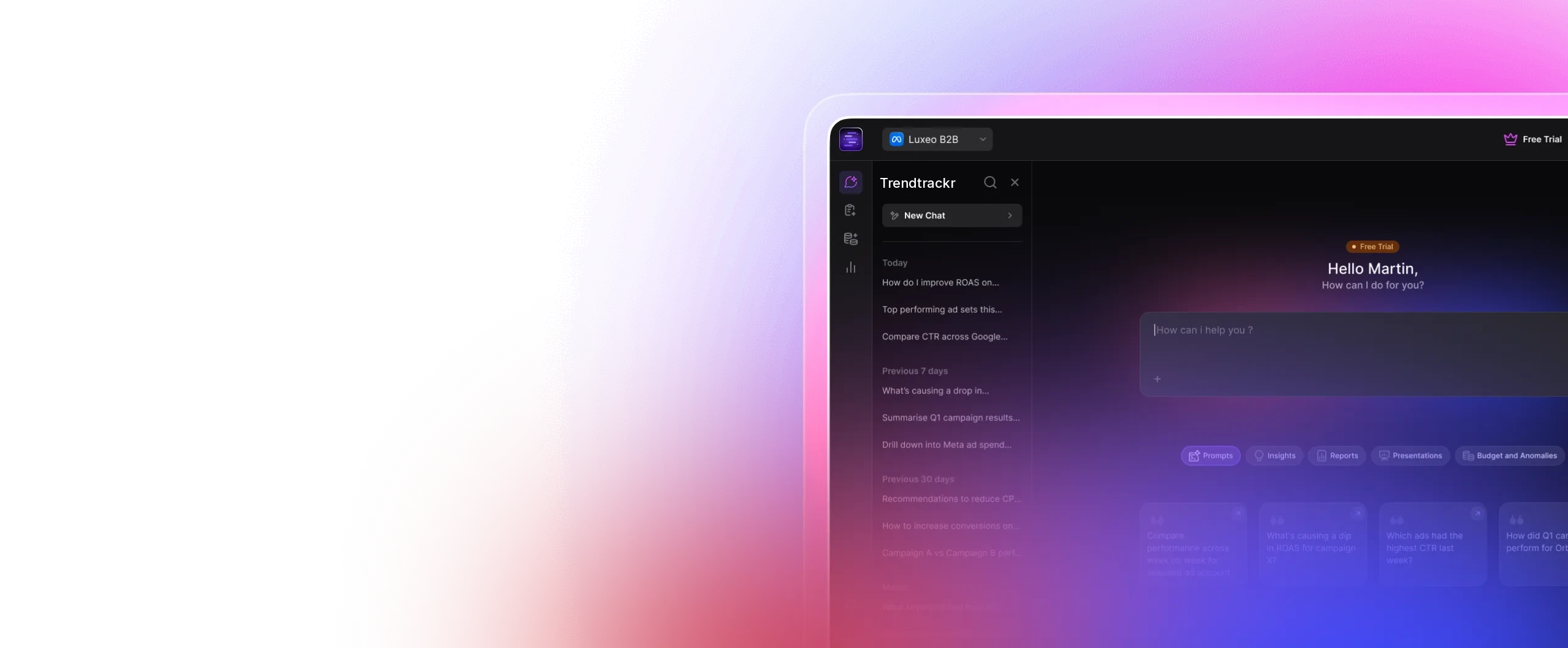
To do competitor analysis for a Shopify brand, pick five to ten competitors and check four things for each one: their store and offers, their paid ads (Meta Ad Library, TikTok's Commercial Content Library and Google's Ads Transparency Center, all free), their organic content on Instagram, TikTok and YouTube, and which creative they keep running. Then turn the patterns into a brief and repeat it every week. The free tools work one competitor at a time. Store-research tools such as TrendTrack add store and product data. Trendtrackr (from $49 a month) tracks competitors' Meta ads and their Instagram, TikTok and YouTube content in one place, tags every creative across 14 axes and turns what's working into briefs.
We make Trendtrackr, so we say so where it comes up. Every fact about a free tool below comes from that platform's own help pages, and every price comes from the vendor's own site, checked on 23 November 2026 (Asia/Dubai). Trendtrackr (trendtrackr.co) is creative intelligence for brands that sell on Shopify. It is not a Shopify app, and it isn't affiliated with TrendTrack (trendtrack.io) or trendtrackr.com.
Last updated: 23 November 2026
What Shopify competitor analysis should cover
Most guides about "Shopify competitor analysis" are about spying on stores: which theme, which apps, which products. That matters if you're hunting for a product to sell. A brand that already has its products usually needs something else: what competitors are saying, how they're saying it, and which ads and posts they keep paying for. Cover these five layers:
| Layer | What to look at | Free source | What it can't tell you |
|---|---|---|---|
| Store and offer | Hero message, prices, bundles, free-shipping threshold, guarantee, email sign-up offer | The competitor's own website | Traffic, conversion rate or sales |
| Meta ads (Facebook and Instagram) | Active ads, start dates, formats, copy, landing pages | Meta Ad Library (facebook.com/ads/library) | Spend or results for ordinary ads; stopped ads |
| TikTok ads | Ads shown in the EEA, Switzerland and the UK: first and last shown, unique users seen (a range), targeting summary | TikTok Commercial Content Library (library.tiktok.com) | Ads shown only in other countries, such as the US |
| Google and YouTube ads | Active ads published through Google, searchable by advertiser name or website | Google Ads Transparency Center (adstransparency.google.com) | Whether the ad is profitable |
| Organic content | Posting rhythm, formats, hooks, topics, comments | Their Instagram, TikTok and YouTube profiles | Reach, saves or audience data (insights are only for the account owner) |
How to do it, step by step
Step 1: Pick five to ten competitors
List your three to five direct rivals: the brands your customers compare you with. Add two or three brands outside your niche whose marketing you admire, plus one or two creators your customers follow. Ten is plenty. Watching thirty brands badly is worse than watching eight properly.
Step 2: Audit each store and offer
Open each competitor's site on your phone, because that's where most of their ad traffic lands. Write down the headline promise, the price of the hero product, any bundle or subscription offer, the free-shipping threshold, the returns promise and the pop-up offer. A shared sheet with one row per competitor is enough. Repeat it monthly. Offers change more often than brand positioning.
Step 3: Pull their active Meta ads
In the Meta Ad Library, choose the country you sell in, select All ads and search the competitor's Facebook Page name. Meta's help centre says you can search all ads that are currently active across Meta's products. For ads about social issues, elections or politics it also shows inactive ads, a spend range and reach, but ordinary commercial ads don't get that. So check on the same day each week and save the ads you want to keep, because a stopped ad disappears. Our guide to seeing competitor ads on Facebook walks through the filters.
Step 4: Check TikTok, Google and YouTube
TikTok's Commercial Content Library is free and needs no TikTok account, but TikTok's help centre says it currently covers ads available to users in the EEA, Switzerland and the UK. If your competitors only advertise in the US, you won't find those ads there. Our TikTok competitor ads guide covers the US workaround. For Google and YouTube ads, search the competitor's name or website in Google's Ads Transparency Center.
Step 5: Read their organic content
Open their Instagram, TikTok and YouTube profiles and look at the last 30 posts. Note the format mix (short video, carousel, static), how often they post, the first line or first three seconds of each video, and which posts clearly beat their normal engagement. Organic posts often show you a hook before it turns up in an ad. Our Instagram competitor analysis guide goes deeper on this step.
Step 6: Turn patterns into a brief
The output of competitor analysis is a decision, not a spreadsheet. Look for patterns that repeat across several brands: the same hook type, the same angle, the same offer structure. Pick one pattern, write a brief for an original ad that uses it in your brand's voice, and test it. Then do the whole thing again next week.
What to track every week
- New ads each competitor launched, and the ones that stopped.
- Ads that have been running the longest. Long-running ads are a public hint that something is working, not proof.
- New offers, bundles and price changes.
- Hooks and formats that appear across more than one brand.
- Organic posts that clearly outperform the account's usual engagement.
- Comments that reveal objections or questions you can answer in your own ads.
Doing it by hand vs using a tool
| Option | Best for | What it covers | Price (monthly billing) |
|---|---|---|---|
| Free libraries + a spreadsheet | One to three competitors, checked occasionally | Meta ads; TikTok ads in Europe; Google and YouTube ads; organic profiles by hand | Free |
| Trendtrackr | Shopify brand creative teams and agencies who want a weekly read and briefs | Meta ads plus Instagram, TikTok and YouTube content from the brands and creators you track; 14-axis tagging; Winner Score; briefs and scripts; MCP connector for Claude and ChatGPT | $49 Starter, $99 Growth, $499 Scale ($39, $79, $399 a month billed yearly) |
| TrendTrack | Store, product and ad research | A store database, products, ads and a Brandtracker | $49 Starter, $89 Pro, $159 Business |
| Meta Ad Library alone | A quick look at one brand's live Meta ads | Facebook, Instagram and Meta's other apps | Free |
Trendtrackr's plans differ in how many brands and creators you track: 5 on Starter, 30 on Growth and unlimited on Scale. It doesn't estimate competitor spend. Its Winner Score rates ads on observable signals instead. If you mostly need store and product data, TrendTrack is the better fit; see Trendtrackr vs TrendTrack. For a wider comparison, see the best ad spy tools for Shopify brands.
Common mistakes
- Copying instead of learning. Use competitor ads to understand angles and formats. Don't reuse their footage, reviews or claims.
- Treating one viral post as a strategy. Look for patterns across brands and weeks.
- Guessing spend. For ordinary ads, the free libraries don't show it. Any spend figure from a third-party tool is an estimate.
- Only watching ads. Organic content is where many brands test hooks first.
- Never writing the brief. If the analysis doesn't change what you make next, it was a research project.
FAQ
What is Shopify competitor analysis?
It's the regular review of what rival Shopify brands sell, how they price and position it, and which ads and organic content they run. For a brand with its own products, the most useful part is usually creative: the hooks, angles, formats and offers competitors keep using.
What free tools can I use for Shopify competitor analysis?
The Meta Ad Library for active Facebook and Instagram ads, TikTok's Commercial Content Library for TikTok ads shown in the EEA, Switzerland and the UK, Google's Ads Transparency Center for Google and YouTube ads, and the competitors' own websites and social profiles.
Can I see a competitor's ad spend or sales?
Not from the free tools for ordinary ads. Meta shows spend ranges only for ads about social issues, elections or politics. Any spend or sales figure in a third-party tool is an estimate, not the store's own data.
How often should I analyse my competitors?
Check ads and organic content weekly, because active ads change and a stopped Meta ad drops out of the library. Review stores and offers monthly.
Is Trendtrackr a Shopify app?
No. Trendtrackr is a web platform you use alongside your store. You don't install anything in Shopify, and it doesn't read your store's data. It tracks your competitors' public ads and content.
What's the difference between Trendtrackr and TrendTrack?
They are different companies. TrendTrack (trendtrack.io) focuses on store, product and ad research. Trendtrackr (trendtrackr.co) is creative intelligence for Shopify brands: competitor ads and content, creative tagging, winner scoring and briefs.
Want this done for your competitors every week?Start a free Trendtrackr trial or see Trendtrackr for Shopify brands.
Sources
All checked 23 Nov 2026 (Asia/Dubai); page dumps saved: - Meta Ad Library, Facebook Help Centre "What is the Meta Ad Library and how do I search it?": https://www.facebook.com/help/259468828226154 - TikTok Commercial Content Library, TikTok Help Center: https://support.tiktok.com/en/account-and-privacy/personalized-ads-and-data/commercial-content-library - Google Ads Transparency Center: https://adstransparency.google.com/ - Instagram insights, Instagram Help Center: https://help.instagram.com/788388387972460 - Trendtrackr pricing: https://www.trendtrackr.co/price - TrendTrack pricing: https://www.trendtrack.io/pricing