Creative brief template for Meta ads: a free template for Shopify brands

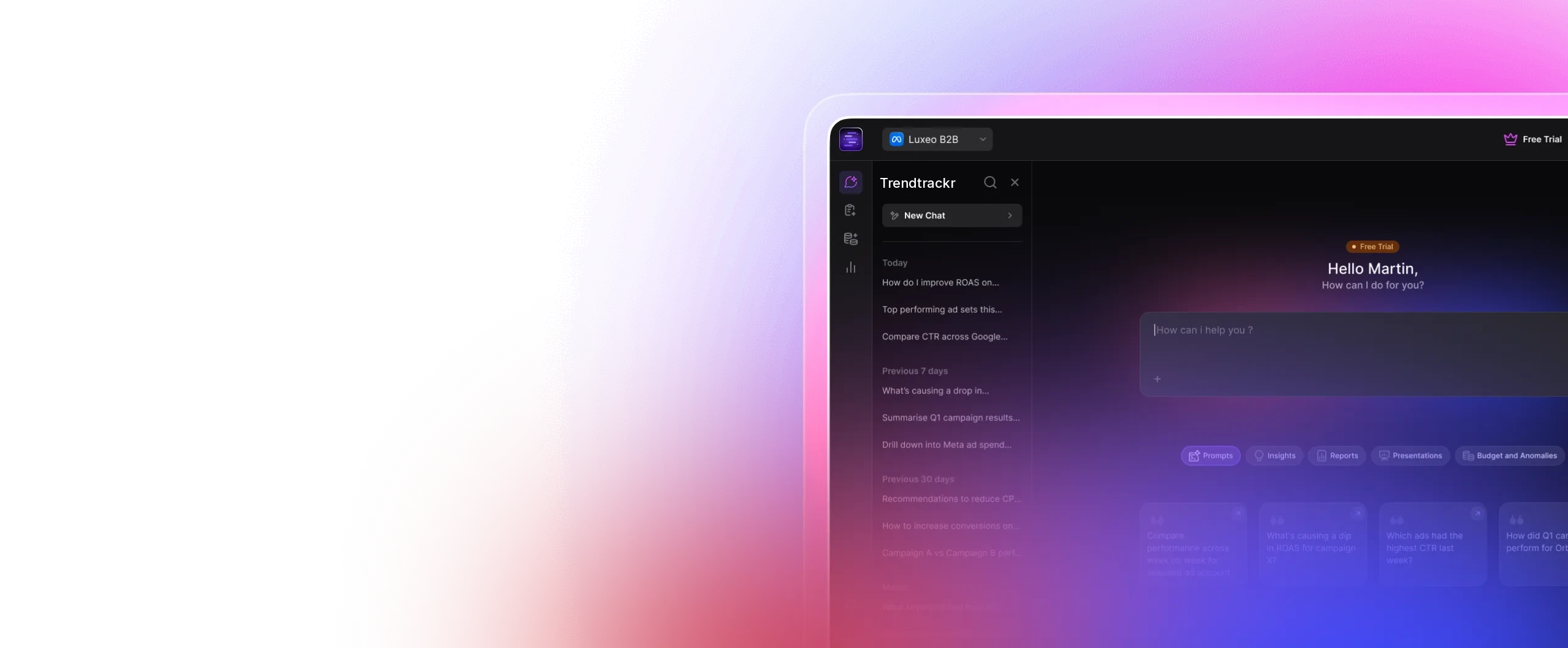
A good Meta ads creative brief fits on one page and answers twelve questions: the goal, the audience, the single angle, the hook for the first three seconds, the proof, the offer, the call to action, the format and placements, the must-say and must-not-say lines, the reference ads, the deliverables, and how you will judge the test. Copy the template below, fill one brief per concept (not per ad), and attach two or three reference ads with the date each one started running in the Meta Ad Library, because an ad that has run for weeks is a better reference than one that launched yesterday. For UGC creators, add deliverables, usage rights and a do/don't list. Trendtrackr (from $49 a month) builds the reference side for you: it tracks the competitors and creators you choose, scores their ads and posts, breaks each one down across 14 creative axes, and turns what's working into briefs, scripts and prompts your team can work from.
We make Trendtrackr, so we say so where it comes up. The template is our own working format. Facts about the Meta Ad Library come from Meta's help centre, and Trendtrackr facts come from our pricing page, both checked on 25 November 2026 (Asia/Dubai). Trendtrackr (trendtrackr.co) is creative intelligence for brands that sell on Shopify. It is not a Shopify app or a product-research tool for dropshippers, and it isn't affiliated with TrendTrack (trendtrack.io) or trendtrackr.com.
Last updated: 25 November 2026
What a Meta ads creative brief is for
A creative brief is the hand-off between the person who knows why an ad should exist (the founder, growth lead or creative strategist) and the person who makes it (an editor, designer or UGC creator). It is not a script and it is not a mood board. Its job is to make one idea testable: one audience, one angle, one hook to try, and a clear way to tell whether it worked.
Most briefs fail in one of three ways. They try to test several ideas at once, so a winning ad teaches you nothing. They describe the product instead of the customer's problem. Or they give no references, so the editor guesses at the format. The template below is built to stop all three.
The template: 12 fields
Copy this into a doc or a spreadsheet row. One brief equals one concept; variations of the same concept (different creators, edits or first lines) go in the deliverables field.
| # | Field | What to write | Example for a Shopify skincare brand (illustrative) |
|---|---|---|---|
| 1 | Goal | The one thing this concept should prove, and the metric | Find a new cold-audience hook that beats our current best on cost per purchase |
| 2 | Audience | Who it is for, in their words, plus awareness level | Women 25–40 who have tried "clean" moisturisers and still get dry patches; problem-aware |
| 3 | Angle | The single reason to buy this concept argues | Works on dry patches in a week without feeling greasy |
| 4 | Hook (first 3 seconds) | The opening line and the opening visual | "I stopped layering three creams" over a close-up of a dry patch |
| 5 | Proof | Why the viewer should believe it | Before/after from a real customer, review count from the store, ingredient shot |
| 6 | Offer | Exactly what is on offer and any deadline | Starter kit with free shipping |
| 7 | Call to action | The action and the words | "Tap Shop Now to get the starter kit" |
| 8 | Format and placements | Video or static, length, placements, safe zones for text | 20–30 s vertical video for Reels and Stories, plus a square cut for Feed |
| 9 | Must say / must not say | Required claims, banned claims, legal lines | Must show the product name in the first 5 s; no medical claims |
| 10 | References | 2–3 reference ads or posts, with why each is there | Competitor ad live since early October (format reference); our own top post this month (tone) |
| 11 | Deliverables | Number of versions, cuts, ratios, hooks to test, deadline | 3 hooks × 1 body, 2 ratios, raw files, due Friday |
| 12 | Test plan | How it will run and what counts as a win | New ad set, same audience as control, judged after a set budget against cost per purchase |
The example column is made up to show the level of detail; it is not a real campaign. Keep the brief to one page. If it needs more, you probably have two concepts.
How to fill the brief from competitor ads
The references and the hook are where most briefs are weakest, and they are the fields competitor research fills best.
- Pull your competitors' active ads. In the free Meta Ad Library, choose your country, pick All ads and search each competitor's Page. Meta's help centre says the library contains all active ads running across Meta's technologies, and each ad shows the date it started running. Our guide to seeing competitor ads on Facebook walks through the filters.
- Shortlist ads that look like winners. An ad that has run for weeks, or a concept with several live variations, is a better reference than a new ad. Our guide to finding winning ads explains the signals and their limits.
- Break each reference down. Write down its hook, angle, format, proof, offer and call to action. Those map straight onto fields 3 to 8 of the template.
- Brief the pattern, not the ad. Use the structure that works and put your own product, customer language and proof into it. Never reuse a competitor's footage, reviews or claims.
- Add organic references. Posts that clearly beat an account's usual engagement on Instagram, TikTok or YouTube often show the next hook before it becomes an ad. See our Instagram competitor analysis guide.
You can't see a competitor's spend or return on ad spend. Meta shows spend ranges only for ads about social issues, elections or politics, so treat every reference as a hypothesis to test.
UGC creator brief: what to add
A UGC brief goes to someone outside your team, so it needs more practical detail and less strategy. Keep fields 1 to 12 for your own records and send the creator this version.
| Section | What to include |
|---|---|
| About the product | Two or three sentences in plain words, plus the one thing to show on camera |
| The angle and hook | The angle from field 3 and two or three opening lines to choose from |
| Talking points | Three points at most, in the order you want them, with the proof to show for each |
| Do | Film vertically in natural light, show the product in hand early, speak to camera as you would to a friend |
| Don't | Read from a script word for word, make claims not in the brief, show other brands' products |
| Deliverables | Number of videos, length, raw clips or edited, file format, deadline |
| Usage rights | Where and how long you can run the content as an ad, and whether you can edit it |
| References | One or two example ads that show the tone and pace you want |
If you need scripts as well as briefs, write the script from the brief, not the other way round. The brief decides what to test; the script is one way of testing it.
By hand vs with a tool
| Option | Best for | Where references come from | Price (monthly billing) |
|---|---|---|---|
| This template + free libraries | A few concepts a month, a small number of competitors | You search the Meta Ad Library and social profiles and note the details by hand | Free |
| Trendtrackr | Shopify brand creative teams and agencies who brief every week | Tracks the brands and creators you choose across Meta ads and Instagram, TikTok and YouTube content; Winner Score on observable signals; outlier multiple for posts; 14-axis breakdown of hooks, angles and formats; turns it into briefs, scripts and prompts; MCP connector for Claude and ChatGPT | $49 Starter, $99 Growth, $499 Scale ($39, $79, $399 a month billed yearly) |
Trendtrackr pulls every active competitor ad from the Meta Ad Library and updates tracking daily. Its 14 creative axes include hook type, CTA, offer, emotion, visual style, persona, ad angle, USP and theme, which are the same things a brief asks for. The Winner Score moves ads through four tiers (Testing, Validated, Scaled, Hero) based on observable signals, not spend estimates, so the references you attach come with a reason. Scripts follow a six-beat structure. Plans differ in how many brands and creators you track (5, 30 or unlimited) and how many creations you get each month (10, 100 or 500). Trendtrackr doesn't make the ads; your team or creators do. See Trendtrackr for Shopify brands or pricing.
If you'd rather brief from Claude or ChatGPT, Trendtrackr's MCP connector lets you run competitor analysis inside the chat; see competitor ad research with Claude MCP.
Common mistakes
- Several ideas in one brief. If the ad wins, you won't know why. One concept per brief.
- No hook written down. "Make it engaging" is not a hook. Write the first line and the first shot.
- References without reasons. Say what each reference is for: the format, the pace, the proof style.
- Copying a competitor's ad. Brief the pattern in your own words and with your own proof.
- No test plan. Decide what counts as a win before the ad goes live, then check creative fatigue once it starts to slow down.
FAQ
What should a Meta ads creative brief include?
The goal, the audience, one angle, the hook for the first three seconds, the proof, the offer, the call to action, the format and placements, must-say and must-not-say lines, two or three reference ads, the deliverables and the test plan. Keep it to one page and one concept.
How is a UGC creator brief different from a creative brief?
A creative brief is your internal plan for one concept. A UGC creator brief is the version you send to a creator: it keeps the angle and hook but adds talking points, a do and don't list, deliverables, deadlines and usage rights, and leaves out internal targets.
How many ads should one brief produce?
One brief covers one concept. Within it, ask for a few variations of the hook or creator so you can see which version of the idea works, while every version still tests the same angle.
How do I use competitor ads in a brief without copying them?
Use them as references for structure: the hook type, format, pace and kind of proof. Write your own lines, use your own product and customer proof, and never reuse their footage, reviews or claims.
Can an AI tool write creative briefs from competitor ads?
Yes, if it can see the ads and break them down. Trendtrackr tracks the competitors and creators you choose, tags each ad and post across 14 creative axes, scores what's working and turns it into briefs, scripts and prompts. It doesn't make the ads.
Is Trendtrackr a Shopify app?
No. Trendtrackr is a web platform for brands that sell on Shopify, their creative teams and agencies. It doesn't install in your store and it isn't a product-research tool for dropshipping.
Want briefs built from what your competitors are running right now?Start a free Trendtrackr trial or see Trendtrackr for Shopify brands.
Sources
All checked 25 Nov 2026 (Asia/Dubai); page dumps saved: - Meta Ad Library, Facebook Help Center "What is the Meta Ad Library and how do I search it?" (all active ads; start date on each ad; extra data for issue, election and political ads): https://www.facebook.com/help/259468828226154 - Trendtrackr pricing, plan contents, 14-axis tagging, Winner Score, competitor data source and MCP: https://www.trendtrackr.co/price