How to find winning ads in your niche: a guide for Shopify brands

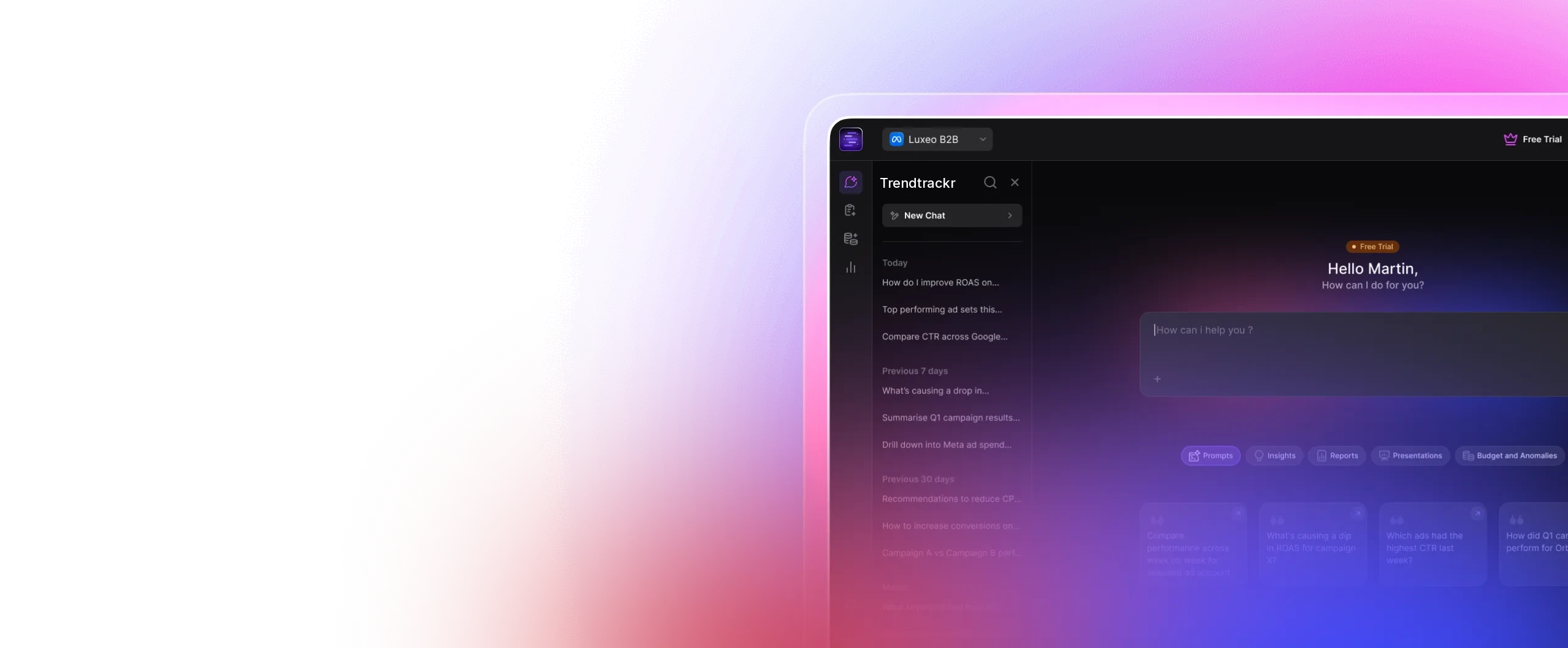
You can't see a competitor's sales or ROAS, so a "winning ad" has to be inferred from public signals: how long the ad has been running, how many variations of the same idea the brand keeps launching, whether the same hook shows up across several brands, and organic posts that clearly beat the account's usual engagement. Start in the free Meta Ad Library, which shows every active ad and the date it started running, then check TikTok's Commercial Content Library (ads shown in the EEA, Switzerland and the UK) and Google's Ads Transparency Center. Shortlist ads that pass at least two signals, treat them as hypotheses, and brief an original ad for your brand. Trendtrackr (from $49 a month) does this continuously for the brands and creators you track: its Winner Score rates ads on observable signals through four tiers (Testing, Validated, Scaled, Hero), and an outlier multiple shows how far a post beats that account's normal performance.
We make Trendtrackr, so we say so where it comes up. Facts about the free libraries come from Meta's, TikTok's and Google's own help and product pages, and Trendtrackr facts come from our pricing page, all checked on 24 November 2026 (Asia/Dubai). Trendtrackr (trendtrackr.co) is creative intelligence for brands that sell on Shopify. It is not a Shopify app or a product-research tool for dropshippers, and it isn't affiliated with TrendTrack (trendtrack.io) or trendtrackr.com.
Last updated: 24 November 2026
What "winning" can and can't mean from the outside
Only the advertiser knows an ad's spend, conversions and return. Everyone else is reading signals. Some are strong, some are weak, and none is proof on its own.
| Signal | Where to see it (free) | Why it suggests a winner | How it misleads |
|---|---|---|---|
| Ad has been running a long time | Meta Ad Library shows the date an ad started running; TikTok's library shows first and last shown | Brands rarely keep paying for an ad that loses money | Some ads run on tiny always-on budgets, or are simply forgotten |
| Many variations of one concept | Several active ads with the same hook or angle and different edits, copy or creators | Brands iterate on ideas that work | Can also mean a brand is still testing |
| Same hook across several brands | Compare competitors side by side | A pattern that spreads across a niche is usually doing something | Brands copy each other, so it can be a fad |
| Organic post far above the account's usual engagement | The brand's Instagram, TikTok or YouTube profile | Shows an idea the audience reacted to, often before it becomes an ad | One viral post can be luck |
| Reach range (TikTok, Europe only) | TikTok Commercial Content Library: estimated range of unique users who saw the ad | Shows the ad actually got distribution | Only covers ads shown in the EEA, Switzerland and the UK |
Third-party "spend" or "revenue" numbers for ordinary ads are estimates. Meta shows spend ranges only for ads about social issues, elections or politics.
How to find winning ads, step by step
Step 1: Define your niche as a list of brands
"My niche" is too vague to search. Write down five to ten brands your customers compare you with, two or three admired brands from adjacent categories, and a few creators your customers follow. Our Shopify competitor analysis guide covers how to pick them.
Step 2: Pull every active Meta ad
In the Meta Ad Library, choose your country, select All ads and search each brand's Page. Meta's help centre says the library contains all active ads across Meta's technologies, and the top of each ad shows the date it first appeared. Sort your notes by that date: the oldest active ads are your first shortlist. Our guide to seeing competitor ads on Facebook walks through the filters.
Step 3: Count variations
For each brand, group the active ads by concept. If one hook or angle has six live variations and everything else has one, that concept is probably carrying the account. Variation counts are often a better hint than age alone.
Step 4: Check TikTok and Google
TikTok's Commercial Content Library (library.tiktok.com) is free, needs no account, and shows first shown, last shown and an estimated range of unique users. It only covers ads available to users in the EEA, Switzerland and the UK. See our TikTok competitor ads guide for what to do if your competitors only advertise in the US. For Google and YouTube ads, search the brand in Google's Ads Transparency Center; our YouTube ads guide covers the filters.
Step 5: Find organic outliers
Open each brand's Instagram, TikTok and YouTube and scan the last 30 posts. Mark any post that is far above that account's usual views or engagement. Compare against the account's own normal, not against other brands: a small brand's outlier can beat a big brand's average. Our Instagram competitor analysis guide goes deeper on this.
Step 6: Shortlist ads that pass two signals
An ad that is old and has several variations, or a hook that is in a long-running ad and in an organic outlier, belongs on the shortlist. An ad that passes only one signal goes on a watch list.
Step 7: Break down why it works, then brief your own
For each shortlisted ad, write down the hook (first three seconds), the angle (the reason to buy), the format, the proof (reviews, demo, before-and-after), the offer and the call to action. Then brief an original ad that uses the pattern in your brand's voice, test it, and see if it wins for you. If you want help diagnosing your own ads as they age, see how to spot and fix creative fatigue.
To hand a shortlisted ad to an editor or UGC creator, use our creative brief template for Meta ads: twelve fields, a UGC creator version and how to attach competitor references without copying them.
By hand vs with a tool
| Option | Best for | How it finds winners | Price (monthly billing) |
|---|---|---|---|
| Free libraries + a spreadsheet | A few competitors, checked weekly | You note start dates, count variations and spot organic outliers by hand | Free |
| Trendtrackr | Shopify brand creative teams and agencies who want the shortlist done for them | Tracks the brands and creators you follow across Meta ads and Instagram, TikTok and YouTube content; Winner Score on observable signals (Testing, Validated, Scaled, Hero); outlier multiple for content; 14-axis breakdown of hooks, angles and formats; briefs and scripts; MCP connector for Claude and ChatGPT | $49 Starter, $99 Growth, $499 Scale ($39, $79, $399 a month billed yearly) |
Trendtrackr's plans differ in how many brands and creators you track (5 on Starter, 30 on Growth, unlimited on Scale) and how many creations you get each month. Every plan includes the full platform. It doesn't make the ads and it doesn't estimate competitor spend. If you're comparing tools, see the best ad spy tools for Shopify brands.
Common mistakes
- Treating "long-running" as proof. It's the strongest free signal, but some old ads are just forgotten. Combine it with a second signal.
- Looking only at ads. Organic outliers often show you the next hook before it turns into an ad.
- Trusting spend estimates. For ordinary ads, no free library shows spend.
- Copying the ad. Copy the pattern, never the footage, reviews or claims.
- Never testing. A competitor's winner is a hypothesis for your brand until your own results say otherwise.
FAQ
What is a winning ad?
An ad that makes the advertiser money at scale. From the outside you can't see that directly, so a winning ad is one whose public signals (how long it has run, how many variations exist, whether its hook spreads across brands) suggest the brand keeps paying for it because it works.
How do I know how long a competitor's ad has been running?
In the Meta Ad Library, the top of each ad shows the date it first appeared on Meta's technologies. In TikTok's Commercial Content Library, the ad details show first shown and last shown dates, for ads available to users in the EEA, Switzerland and the UK.
Is a long-running ad always a winner?
No. It's the best free signal, but an ad can keep running on a small budget or simply be forgotten. Look for a second signal, such as several live variations of the same concept.
Can I see a competitor's ad spend or ROAS?
No. Meta shows spend ranges only for ads about social issues, elections or politics, and nobody outside the business can see its return on ad spend. Third-party spend figures are estimates.
How does Trendtrackr find winning ads?
Its Winner Score rates each ad on observable signals, not spend estimates, and moves it through four tiers as it proves out: Testing, Validated, Scaled and Hero. Content is scored with an outlier multiple that shows how far a post beats that account's normal performance. Trendtrackr doesn't make ads; it turns the winners into briefs and scripts for your team.
Is Trendtrackr a product-research tool for dropshipping?
No. Trendtrackr is creative intelligence for brands that already sell their own products on Shopify. It looks at what competitors' ads and content say and how, not at which products to sell.
Want a weekly shortlist of your niche's winning ads and content?Start a free Trendtrackr trial or see Trendtrackr for Shopify brands.
Sources
All checked 24 Nov 2026 (Asia/Dubai); page dumps saved: - Meta Ad Library, Facebook Help Center "What is the Meta Ad Library and how do I search it?" (active ads; start date shown on each ad; extra data for issue, election and political ads): https://www.facebook.com/help/259468828226154 - Meta Business Help Center "About the Meta Ad Library": https://www.facebook.com/business/help/2405092116183307 - TikTok Commercial Content Library, TikTok Help Center: https://support.tiktok.com/en/account-and-privacy/personalized-ads-and-data/commercial-content-library - Google Ads Transparency Center: https://adstransparency.google.com/ - Trendtrackr pricing, Winner Score and plan contents: https://www.trendtrackr.co/price